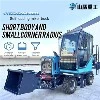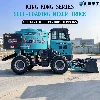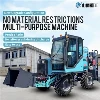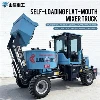
The crawler-type concrete mixer truck is a piece of construction machinery that integrates concrete mixing with self-propelled mobility. Its core design-combining a crawler undercarriage with a mixing unit-overcomes the mobility limitations that traditional mixer trucks face in complex terrain. Such equipment offers distinct advantages in field construction environments, such as mining sites and water conservancy projects.
Key aspects of the crawler mixer truck's design include power distribution and spatial layout. A single diesel engine powers the hydraulic system to perform two functions: driving the crawler travel mechanism via a transmission and rotating the mixing drum via a hydraulic motor. The mixing drum is designed with a 31-degree tilt angle; this configuration ensures thorough material mixing while facilitating gravity-assisted discharge. The rotation speed is maintained at approximately 32 rpm, striking a balance between mixing efficiency and the prevention of material segregation.
Compared to traditional wheeled mixer trucks, the primary distinction of the crawler design lies in its off-road mobility. A combination of a 450mm wading depth and a 1650mm wheelbase enables stable movement across challenging surfaces, such as soft or muddy ground. However, its top speed of 20 km/h indicates a design priority focused on operational stability rather than transport efficiency. The discharge rate of 1 m³/min and loading rate of 2 m³/min reflect the equipment's suitability for continuous, small-batch operations.