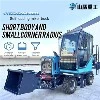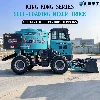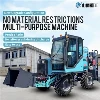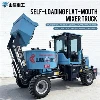
Regarding tires, solid tires are the preferred choice. Made entirely of rubber, they offer exceptional puncture resistance and minimal deformation during operation, ensuring high stability and efficiency-particularly during low-speed, high-intensity tasks.
In terms of power, these forklifts are typically equipped with high-output engines. These engines support independent steering, drive, and braking systems, enabling more effective suspension, acceleration, braking, and maneuvering.
The mast is a critical component of a 4WD forklift; it must be free from deformation and weld failures. The clearance between the inner and outer mast channels must be appropriate-not exceeding 1.5 mm-and the rollers must operate smoothly without cracks.
Lifting chains must have uniform tension, and chain pitch elongation must not exceed 4% of the original length. The fork carriage must not be severely deformed, and the forks themselves must be free of cracks; the heel angle must not exceed 93°, thickness must remain at least 90% of the original specification, and the height difference between the fork tips must not exceed 3% of the horizontal fork length.
Hinge connections between the lift cylinders and the mast, as well as between the tilt cylinders, mast, and chassis, must be secure and flexible with proper clearance. Cylinder seals must be effective, and the lifting speed under full load must be at least half of the standard rated speed.
The overhead guard and load backrest must ensure safety. The chassis oscillation angle generally ranges from ±30° to ±40°. Steering systems are relatively simple; some models utilize a standard steering drive axle to achieve a tight turning radius.
Regarding axles, the rear axle is fixed to the chassis, while the front axle can oscillate vertically relative to the chassis. During lifting operations, hydraulic cylinders maintain the mast's lateral stability; during travel, the upper and lower cylinder chambers are interconnected via damping orifices to ensure a smooth ride.
4WD forklifts require a long wheelbase and wide track width to enhance both lateral and longitudinal stability. They offer good maneuverability, operate at appropriate speeds, and possess necessary gradeability.
The driver's seat should be positioned towards the front to provide the operator with excellent visibility.
Various drive systems are available, including mechanical transmission, mechanical transmission with hydraulic shifting, hydrodynamic transmission, and hydrostatic transmission. The full-power matching method is employed, with the load condition set to climbing a slope at full capacity.
In addition, a four-wheel-drive forklift requires high ground clearance, off-road tires with a high rubber content, front-wheel drive capability, and a compact engine and transmission design to ensure excellent performance in off-road environments.